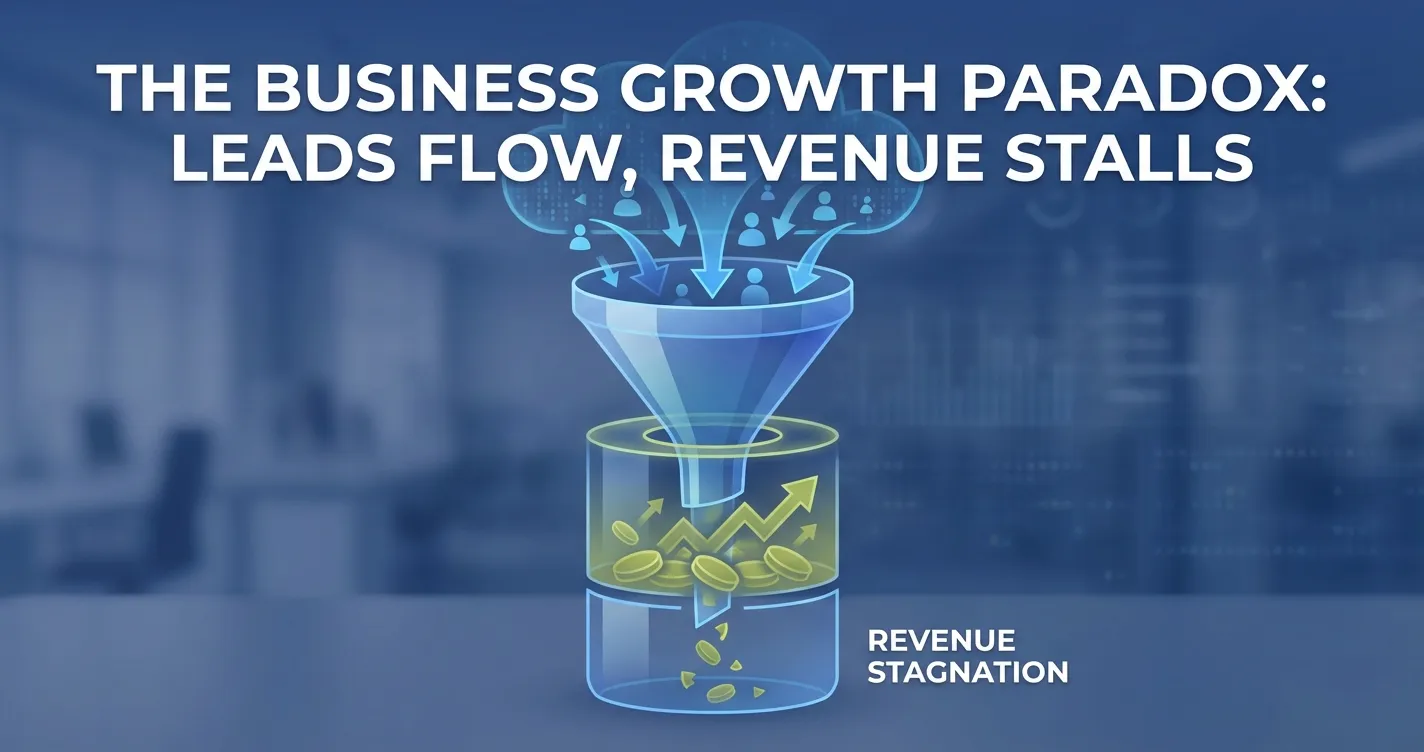
The $2.6 Million Question: Why More Leads Isn't Working
Here's a statistic that should make every business owner uncomfortable: Companies waste an average of 71% of their inbound leads due to poor follow-up and broken conversion processes, according to research from Forrester. For a business generating 500 leads per month at a $500 average customer value, that's $2.6 million in lost annual revenue — not from bad marketing, but from systemic failures that most business owners don't even know exist.
You've invested in marketing. The leads are coming in. But somehow, revenue isn't growing at the same rate. What's going on?
This paradox — more leads without more revenue — affects businesses across every industry. They're doing everything "right" according to marketing playbooks: running targeted ads, optimizing websites, investing in SEO, building email lists. Yet revenue barely moves. Worse, many find themselves spending more on marketing each quarter just to maintain the same revenue levels.
The instinct is to blame lead quality. "They're not qualified enough." "They're tire-kickers." "They're not ready to buy." But jumping to this conclusion sends businesses down the wrong path — spending even more money chasing "better" leads while ignoring the real problem hiding in plain sight.
Why Traditional Solutions Don't Work
When leads increase but revenue stays flat, most business owners reach for one of four common "solutions":
Better quality leads. This leads to sophisticated targeting, higher cost-per-lead channels, and a shrinking prospect pool. While lead quality matters, narrowing targeting too much strangles your pipeline entirely. One manufacturing client spent $340,000 on "premium" lead sources before discovering their real problem: proposals took 14 days to deliver while competitors responded in 48 hours.
More aggressive follow-up. This means hiring more salespeople, adding CRM automation, and sometimes becoming so persistent you annoy potential customers. But if conversion rates are fundamentally broken, more follow-up just means annoying more people faster. Research shows 44% of salespeople give up after one follow-up — but that's often a symptom of a broken system, not lazy salespeople.
A different marketing channel. "Maybe Facebook isn't working — let's try Google." "Maybe we need TikTok." "Maybe direct mail." Channel-hopping burns cash and prevents building institutional knowledge needed to master any single channel. The average business cycles through 3-4 primary marketing channels before realizing channels aren't the problem.
A better sales team. Fire underperformers, hire "closers," invest in training. This helps marginally, but if the system is broken, even great salespeople struggle. You'll burn through expensive talent and wonder why turnover exceeds 35% annually — double the rate of companies with optimized sales systems.
These solutions aren't necessarily wrong — but they're almost never the real problem. They're symptoms of something deeper preventing your business from converting the leads you already have.
The Hidden Constraint: What's Actually Limiting Your Growth
In almost every case where leads grow but revenue doesn't, there's a hidden constraint somewhere in your system. This constraint acts as a bottleneck, limiting throughput regardless of how many leads you pour into the top of the funnel.
The Theory of Constraints, developed by Dr. Eliyahu Goldratt, teaches that every system has exactly one constraint limiting performance at any given time. Fix that constraint, and performance improves — until you hit the next constraint. Ignore it, and no amount of effort anywhere else matters.
Here are the four most common constraints in businesses struggling with the leads-but-no-revenue problem:
Constraint #1: Capacity Bottlenecks
Your team literally can't handle the volume. Sales calls go unreturned because salespeople are maxed out. Quotes take a week because operations is overwhelmed. Customer inquiries sit in inboxes because no one has time to respond.
Warning signs: Response times increasing, sporadic follow-up, quality suffering as people rush, top performers burning out, deteriorating customer experience.
Why it stays hidden: Busy teams look productive. Everyone's working hard. The problem isn't visible until you measure the gap between leads received and leads properly handled.
The real cost: Leads contacted within 5 minutes are 9x more likely to convert than leads contacted after 30 minutes (InsideSales.com research). If your capacity constraint means average response time is 4 hours, you're losing 78% of potential conversions before your first conversation.
Industry benchmarks:
- B2B services: Average response time should be under 1 hour
- E-commerce: Under 15 minutes for high-intent inquiries
- Healthcare/MedSpa: Under 30 minutes for consultation requests
- Professional services: Same business day for complex inquiries
Constraint #2: Conversion Friction
Something in your sales process creates friction that stops leads from progressing. Maybe your proposal process is cumbersome. Maybe pricing is confusing. Maybe there's a step in the buying journey that consistently causes drop-off.
Warning signs: Leads engage initially but disappear at specific stages, win rates below industry benchmarks, sales cycles longer than competitors, same objections surfacing repeatedly.
Why it stays hidden: Salespeople attribute lost deals to external factors ("they weren't ready," "budget issues," "competitor undersold us") rather than identifying systemic process problems.
The real cost: A 10% improvement in conversion rate equals a 10% increase in leads — but costs far less. If your conversion constraint limits you to 15% close rate when industry benchmark is 25%, you're leaving 40% of potential revenue on the table.
Industry conversion benchmarks:
- B2B SaaS: 15-25% qualified lead to customer
- Professional services: 20-35% proposal to close
- Healthcare/Aesthetics: 40-60% consultation to treatment
- Home services: 25-40% estimate to job
Constraint #3: Retention Leakage
You're losing customers as fast as you gain them. New leads replace churned clients rather than adding to your base. Your business runs hard just to stay in place.
Warning signs: Customer lifetime value barely exceeds acquisition cost, low repeat purchase rates, minimal referrals, volatile month-to-month revenue.
Why it stays hidden: Marketing teams focus on acquisition metrics, celebrating new leads without visibility into post-sale outcomes. Finance sees churn, but it's disconnected from marketing conversations.
The real cost: Acquiring a new customer costs 5-25x more than retaining an existing one (Harvard Business Review). If your retention constraint means average customer tenure is 6 months instead of 24 months, you need 4x as many new customers just to maintain revenue — making growth mathematically impossible without fixing retention.
Retention benchmarks by industry:
- SaaS/Subscription: 90%+ annual retention target
- Professional services: 80%+ client retention
- Healthcare/MedSpa: 60%+ patient return rate
- Retail/E-commerce: 25-40% repeat purchase rate
Constraint #4: Throughput Ceilings
Your delivery can't scale with demand. Operations is the bottleneck — you can't fulfill orders fast enough, deliver services consistently, or maintain quality at higher volumes.
Warning signs: Extending delivery times, inconsistent quality, increasing customer complaints, overloaded top operators while new hires struggle, fear of marketing more aggressively.
Why it stays hidden: Sales and marketing measure leads and pipeline. Operations measures fulfillment. The two rarely sit in the same room. The constraint lives at the handoff point that no one owns.
The real cost: Throughput constraints create growth ceilings. No matter how many leads you generate, you can only serve X customers. Worse, quality issues from operating at capacity damage reputation, making future marketing less effective. One client discovered their throughput constraint cost them $890,000 in referrals they couldn't accept.
How to Find Your Constraint: A 5-Step Diagnostic Process
The first step is counterintuitive: stop adding more inputs (leads) and start examining your system. More fuel in a broken engine causes more damage.
Here's the structured approach we use in our AI Revenue Audit process to identify the true constraint:
Step 1: Map Your Complete Customer Journey
Document every step a lead takes from first contact to revenue and beyond. Be specific. Include all handoffs, decision points, and actions required. Most businesses have never mapped this end-to-end.
For a typical service business:
Lead captured → Initial response → Follow-up call → Qualification → Needs assessment → Proposal creation → Proposal delivery → Negotiation → Close → Onboarding → Service delivery → Invoice → Payment → Satisfaction check → Retention sequence → Referral ask → Repeat purchase
Key questions at each stage:
- Who is responsible?
- What triggers the next step?
- What can cause delays?
- Where do handoffs occur?
Step 2: Measure Conversion at Each Stage
What percentage of leads move from one stage to the next? Don't guess — measure. If you don't have data, start collecting now and revisit this analysis in 30-60 days.
Look for the biggest drop-off points. If 80% of qualified leads receive proposals but only 15% of proposals close, your constraint is probably in the proposal-to-close process.
Create a conversion table:
| Stage | Volume In | Volume Out | Conversion % | Time in Stage |
|-------|-----------|------------|--------------|---------------|
| Lead to Contact | 100 | 65 | 65% | 4 hours avg |
| Contact to Qualified | 65 | 40 | 62% | 2 days avg |
| Qualified to Proposal | 40 | 35 | 88% | 5 days avg |
| Proposal to Close | 35 | 8 | 23% | 14 days avg |
This example shows the constraint clearly: proposal-to-close conversion is the bottleneck.
Step 3: Calculate Time at Each Stage
How long does each stage take? Where do leads get stuck? Long delays at any stage indicate a constraint — either capacity or process.
If leads wait 3 days for initial follow-up, that's a capacity constraint. If proposals take 2 weeks to create, that's a process constraint.
Benchmark your times against:
- Industry standards
- Your top competitors
- Your own best-case scenarios
- Customer expectations
Step 4: Interview the People Doing the Work
Your frontline team knows where problems hide. Ask them:
- What prevents you from moving leads through faster?
- What resources do you lack?
- What requests from customers can't you fulfill?
- What causes deals to stall?
- If you could change one thing about our process, what would it be?
Listen without defensiveness. They're not criticizing — they're diagnosing.
Step 5: Calculate the Constraint's True Cost
Look at your data. Where is the biggest drop-off? Where is the longest delay? Where are customers expressing the most frustration?
Then calculate the actual dollar impact:
Constraint cost formula:
(Leads lost at constraint × Average customer value × Expected conversion if fixed) = Annual revenue impact
Example: 500 leads/month × 40% lost at proposal stage × $2,000 ACV × 50% expected conversion improvement = $2.4M annual impact
That number justifies significant investment in fixing the constraint.
The Five Focusing Steps: A Systematic Approach to Constraint Elimination
The Theory of Constraints provides a proven methodology for eliminating constraints:
Step 1: Identify the constraint. We covered this above. Find the one thing limiting your throughput. Don't assume — prove it with data.
Step 2: Exploit the constraint. Before adding resources, maximize what you have. If salespeople are the constraint, eliminate every non-sales task from their plate. If proposals are the constraint, create templates and streamline approvals. This step alone often produces 20-40% improvement.
Step 3: Subordinate everything else. The rest of the organization should support the constraint, not compete with it. If your constraint is delivery capacity, marketing should slow down until delivery catches up. This feels wrong but it's essential — generating leads you can't convert wastes money and damages relationships.
Step 4: Elevate the constraint. Now add resources. Hire more people, invest in better tools, add capacity. Do this AFTER exploiting what you have, not before. Many businesses skip to this step and wonder why throwing money at the problem doesn't work.
Step 5: Repeat. Once you fix one constraint, another emerges. That's progress. Find the new constraint and repeat the process. Growth is a series of constraint eliminations.
The Math That Changes Everything
Here's why constraint focus matters more than lead generation:
Scenario A: Double your leads
- Current: 500 leads/month × 15% conversion = 75 customers
- After: 1,000 leads/month × 15% conversion = 150 customers
- Cost: 2x marketing spend
- Result: 100% revenue increase at 100% cost increase
Scenario B: Fix your constraint
- Current: 500 leads/month × 15% conversion = 75 customers
- After: 500 leads/month × 25% conversion = 125 customers
- Cost: One-time process improvement investment
- Result: 67% revenue increase at fraction of cost
The math is clear: fix the constraint first, then pour in more leads.
Real Results: What Constraint Elimination Looks Like
When businesses properly identify and eliminate their true constraint, the results compound:
MedSpa practice (Capacity constraint): Implemented AI-powered appointment scheduling and automated follow-up sequences. Response time dropped from 4 hours to 5 minutes. Result: 340% increase in consultation bookings, $115K tracked revenue in 90 days.
Manufacturing company (Conversion constraint): Streamlined proposal process from 14 days to 48 hours using AI-generated templates and automated pricing. Result: Win rate increased from 18% to 34%, adding $2.3M to pipeline in first quarter.
Billboard advertising company (Throughput constraint): Built strategic content system that qualified leads before sales contact, reducing time-wasters by 60%. Result: $190K tracked revenue from content campaign, with sales team handling 40% more qualified opportunities.
Each of these businesses had tried "more leads" before discovering their true constraint. The lead generation efforts only worked after the constraint was eliminated.
The Uncomfortable Truth About Your Marketing
Most business owners think their problem is marketing. It rarely is. The real problem is systemic — something in how the business operates that prevents leads from converting to revenue.
Pouring more leads into a broken system is like pouring water into a bucket with holes. The solution isn't more water — it's fixing the holes.
We've seen businesses cut marketing spend by 50% while growing revenue by 30% — simply by fixing constraints first. The leads they already had were enough; they just weren't being converted properly.
Taking Action: Your Constraint Diagnostic Checklist
Before spending another dollar on lead generation, answer these questions:
Capacity assessment:
- What's your average lead response time?
- How many leads per salesperson per month?
- Where are your team members most overloaded?
Conversion assessment:
- What's your conversion rate at each pipeline stage?
- Where's the biggest drop-off?
- How does this compare to industry benchmarks?
Retention assessment:
- What's your customer lifetime value?
- What's your churn rate?
- How many customers have you lost in the last 90 days, and why?
Throughput assessment:
- Could you handle 50% more customers tomorrow?
- Where would your delivery break down first?
- What's your current capacity utilization?
If you can't answer these questions with data, start there. The leads will still be there when you're ready — and you'll actually be able to convert them.
Frequently Asked Questions
Why do more leads not always mean more revenue?
More leads without more revenue typically indicates a constraint somewhere in your system — capacity, conversion, retention, or throughput bottleneck. Until you identify and fix this constraint, additional leads simply expose the limitation further. The constraint limits how much business you can actually process, regardless of inputs.
How do I know if my lead quality is the problem or my sales process?
Measure conversion rates at every stage of your pipeline and compare to industry benchmarks. If your lead-to-contact rate is healthy (65%+) but proposal-to-close is weak (below 20% for most B2B), the problem is your process, not your leads. Also interview lost prospects — their feedback reveals whether they weren't qualified or whether your process lost them.
What's a good lead response time for B2B businesses?
Research consistently shows leads contacted within 5 minutes are 9x more likely to convert than those contacted after 30 minutes. For B2B services, aim for under 1 hour during business hours. For high-intent inquiries (pricing requests, demo requests), under 15 minutes significantly improves conversion. Most businesses average 4+ hours, creating a massive competitive disadvantage.
How much can fixing a constraint improve revenue without increasing leads?
Fixing a true constraint typically improves throughput by 20-50% without any additional lead generation. We've seen clients increase revenue by 67% simply by improving their constraint conversion rate from 15% to 25%. The compounding effect means small improvements at the constraint have outsized impact on total revenue.
Should I stop all marketing while I fix my constraint?
Not necessarily, but you should match lead flow to your actual capacity. Generating leads you can't properly handle wastes money and damages relationships with potential customers who receive poor experiences. Consider reducing marketing spend temporarily and reallocating those funds to constraint elimination, then scaling marketing once throughput improves.
How long does it take to identify and fix a business constraint?
Identification typically takes 2-4 weeks of systematic analysis — mapping the customer journey, measuring conversion at each stage, interviewing team members, and calculating costs. Fixing the constraint varies: some solutions (like implementing response automation) produce results within days, while others (like restructuring delivery operations) take 60-90 days. The ROI timeline usually shows measurable improvement within 30-60 days of implementation.
The Path Forward: Diagnosis Before Implementation
This diagnostic approach — identifying the true constraint before implementing solutions — is the core principle behind how we work with clients. Before recommending any solution, we map your entire customer journey, measure performance at every stage, identify your true constraint, and design an intervention that addresses the root cause.
It's slower than hiring an agency to run ads. It requires more introspection than buying a new CRM. But it works — because it addresses what's actually wrong rather than what's easy to sell.
If you're generating leads but not revenue, the problem isn't your marketing. It's a constraint hiding somewhere in your system. Find it, fix it, and watch what happens when your business finally has room to grow.
Continue Reading
AI Won't Replace Your Business — But Businesses Using AI Will
The threat isn't artificial intelligence itself. It's competitors who figure out how to use it before you do. Here's what that means for your business.
MedSpa GrowthMedSpa Marketing That Actually Works (Without Discounting Your Services)
Most MedSpa marketing advice leads to a race to the bottom. Here's the patient acquisition system that builds practice value while filling your schedule.